
A paint meter can put a number on a beautiful fender. What it cannot do is tell you whether the fender got that way after a stone chip, a careful restoration, or a late-night disagreement with a telephone pole. Bring the gauge to the inspection. Leave the verdict until you’ve looked at the rest of the car.
Start by asking what the panels are made of. A conventional automotive gauge for steel and aluminum uses different methods for the two metals. Check that the instrument supports both if the car has both. Fiberglass needs a different method, such as a suitable ultrasonic gauge. A blank reading on a composite panel tells you more about your instrument than the seller’s honesty.
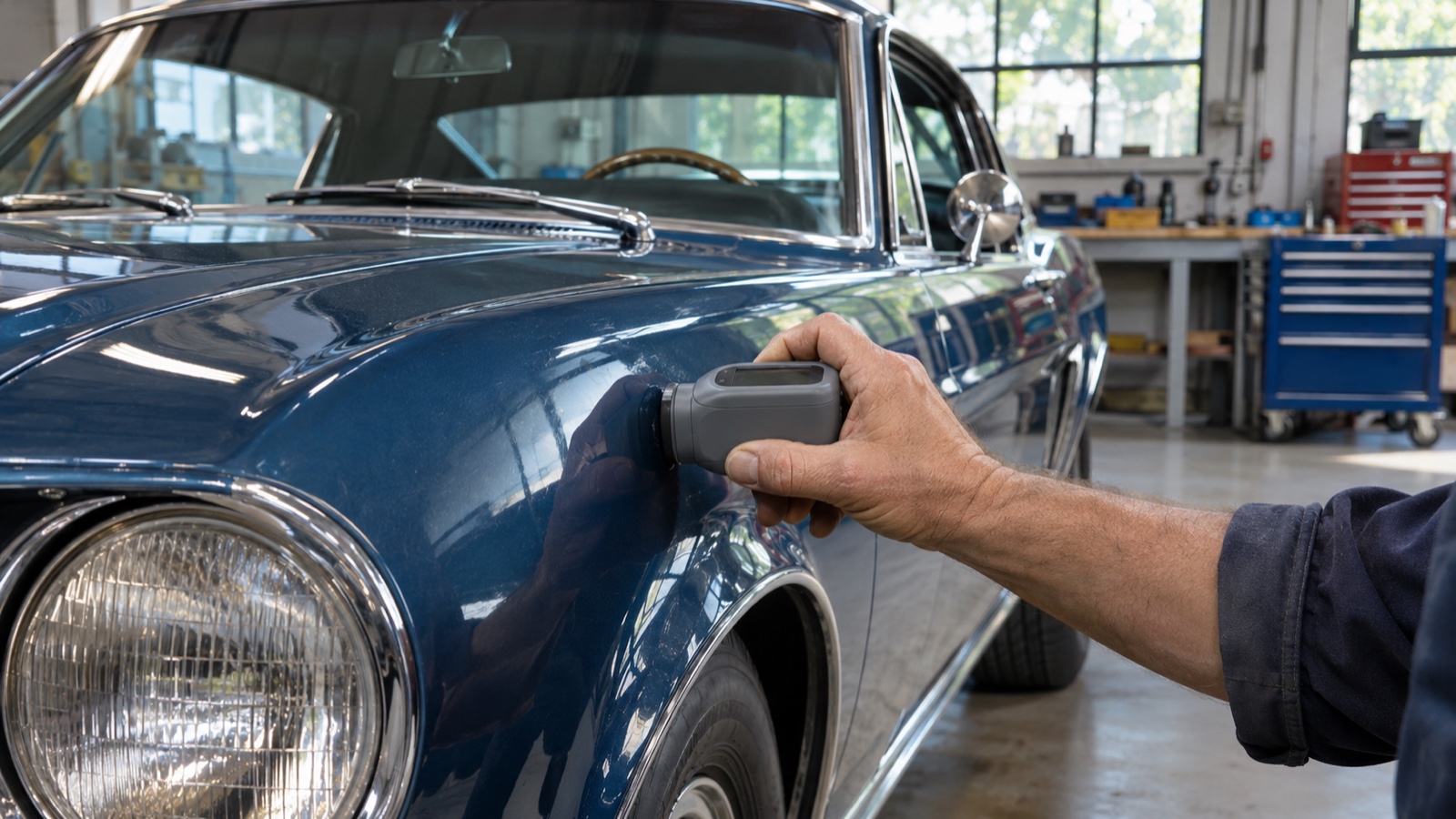
With the seller’s permission, check the gauge on its reference plates and foils according to its instructions. Make sure the panel and probe are clean. Set the probe flat on the surface, away from sharp edges and tight curves, and let it take a reading without sliding it across the finish. Take several readings across each comparable panel and note them. Use one unit throughout. A mil is a thousandth of an inch; it isn’t a millimeter. That little mix-up can turn a harmless repaint into a genuinely impressive arithmetic problem.
Compare like with like. Look at the left and right steel fenders, for example, rather than comparing a steel door to an aluminum hood. A consistently higher cluster may suggest additional paint. An isolated high spot can give an inspector a place to look more closely for filler or prior work. Neither pattern proves collision damage, and there is no universal thickness that separates factory paint from everything that came later.
Follow the readings with your eyes. Look for masking edges, overspray, mismatched texture and signs that hardware has been removed. Ask for restoration photos or body-shop invoices. An honest repaint can be the best thing that happened to a good driver. On a car carrying a premium for original paint, those same findings matter a great deal. If the number and the paperwork tell different stories, commission a marque specialist’s inspection before putting down money.
A meter is cheap compared with the wrong car. Its best reading is the one that makes you ask a better question.
Technical reference: DeFelsko, Automotive Paint Inspection: https://www.defelsko.com/resources/automotive-paint-inspection-paint-meters